

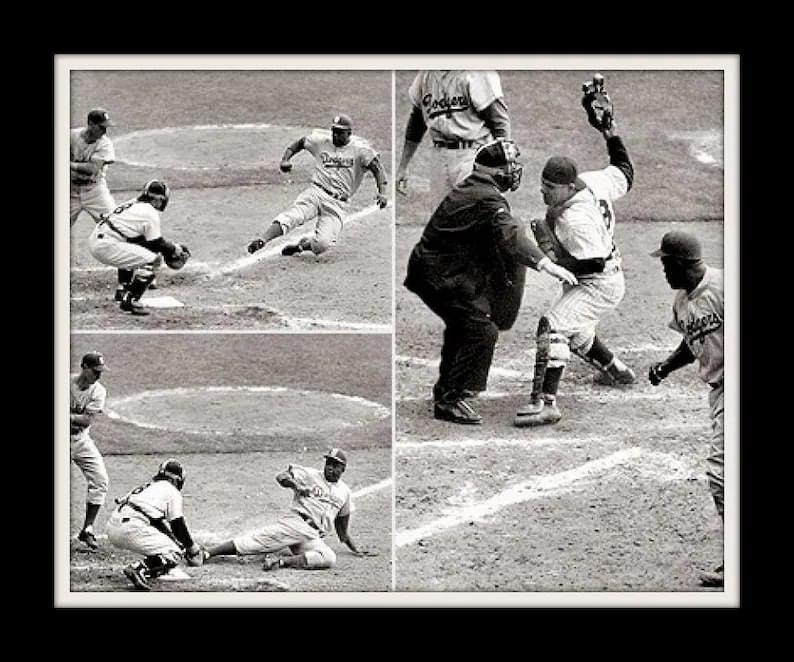
In Game 1 of the 1955 World Series, Jackie Robinson stole home.
It almost never works at the professional level. It is bold, it is rare, and when it does work, nobody forgets it.
Yogi Berra was the Yankees catcher that day. He was certain he had Robinson tagged out. The umpire disagreed. Yogi argued.
And then for the next sixty years, every time he walked past a photo of the play at his museum, he would mutter, “You’re out.” When Rachel Robinson, Jackie’s wife and lifelong keeper of his legacy, would see Yogi at events, they had the same exchange every single time.
“Safe,” she would say.
“Out,” he would say.
Warmly. Every time. For sixty years.
Yogi was there. He was the catcher. He had a real angle and real skin in the game.
Most of us, when we form strong opinions about other people’s conflicts, are not Yogi.
We are forty rows back, just as certain.
Here Is How It Actually Happens
Someone you trust tells you their version of a conflict. You feel the weight of their hurt. They seem credible. You care about them. And before you have talked to anyone else, before you have asked a single question of anyone on the other side, you have already made the call.
Out.
And you were not even at the plate.
This is how gossip works. Not always through malice. Usually through proximity. Someone who is hurting tells their story to someone they trust. That person carries it to someone else. By the time it reaches you, it is a highlight reel with no context, no other perspective, and no invitation to find out more.
You just received someone’s edited version of a play you were not there for.
And here is what makes it spiritually dangerous: a half-truth does not feel like a half-truth. It feels exactly like the truth. It lands with full weight. It sounds completely reasonable. That is what makes it so damaging.
What the Bible Actually Says About This
This is not a new problem. The Bible addresses it directly.
Proverbs 18:17 says the first to state his case seems right until the other side is heard. That is not a criticism. It is just an honest observation about human nature. Of course the first version sounds convincing. You have not heard anything else yet.
Jesus was practical about this in Matthew 18. He did not say talk to everyone except the person involved. He said go to the person. Directly. First. Not after you have already told three other people what you think happened. First.
Proverbs 26:20 puts it plainly: without wood, a fire goes out. Without gossip, conflict dies down.
Every time we pass along an incomplete story, we are adding wood to a fire we may not fully understand. And fires do not stay where you put them.
The Damage Is Real
When half-truths circulate unchallenged, real people get hurt.
Not just the people the story is about. The people hearing it get hurt too. They are asked to carry a weight, form a judgment, and pick a side based on information that is incomplete at best and distorted at worst.
It creates confusion in communities where trust is supposed to be the foundation. It makes people question things they do not have enough information to actually evaluate. And it is incredibly hard to undo. You can correct a rumor, but you cannot un-plant the seed of doubt it left behind.
That is not neutral. That is not just people processing their hurt. That is damage.
So What Do You Actually Do?
This is not complicated. It is just uncomfortable.
When someone brings you a story about a conflict, ask who they have talked to directly. Not to shut them down, but because you actually want to understand what happened before you form an opinion.
Before you land on a strong verdict, go to the source. If the story involves a leader, a friend, or a community you are part of, the people closest to the situation deserve to be heard before you decide what you think.
When you hear something that does not add up, say so. You do not have to debate anyone. You can simply say, “I do not think I have the full picture. Have you talked to them directly?”
Ask yourself what you are getting out of the certainty. Sometimes a strong opinion feels good because it gives us something solid to hold. But if it is built on one side of a story, it is not solid ground. It is just comfortable.
The Question Worth Sitting With
Yogi Berra and Rachel Robinson greeted each other the same way for sixty years. “Safe.” “Out.” And they did it warmly. Neither of them made being right the whole point of the relationship.
Most of us cannot say the same. We receive one version of a play we were not there for, and we hold it, defend it, and sometimes build a whole narrative around it without ever going to the source.
Before you call it: Were you at the plate? Have you heard from everyone involved? Have you actually gone to the people closest to the situation and asked what happened?
Because you might be right. But you also might be forty rows back, holding a verdict on a play you never actually saw.